
The Indian government has directed oil refineries to increase LPG production to ensure a stable supply of domestic cooking gas, amidst concerns over potential disruptions from the escalating Middle East conflict and its impact on imports.

Prime Minister Narendra Modi has begun a six-day tour of the UAE, the Netherlands, Sweden, Norway and Italy to strengthen bilateral relations amid geopolitical challenges. The trip will focus on energy security, trade, and technological cooperation.
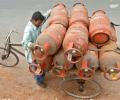
Argentina has significantly increased its LPG exports to India to help mitigate shortages caused by the ongoing conflict in West Asia. This partnership is becoming increasingly important for India's energy security.

The closure of the Strait of Hormuz has disrupted some 20 per cent of the global flows but even if it opens, damages to production facilities in the region will take time to repair, points out Sunita Narain.

Reliance Industries is expected to report largely flat performance for its fourth quarter (January-March, Q4) of FY26, with weakness in the oil-to-chemicals (O2C) business and muted retail growth likely to offset steady gains in the telecommunications segment.

Around one full month of supply is firmly arranged with additional procurement being continuously finalised, and oil companies are successfully delivering over 5 million cylinders every day.
The International Energy Agency (IEA) has proposed immediate demand-side measures, including remote work, lower speed limits, and reduced air travel, to mitigate the impact of a global oil supply shock caused by Middle East disruptions.

Suzuki Motorcycle India Ltd (SMIPL) has revised its domestic two-wheeler sales growth estimate for FY27 downwards from 7-8 per cent, citing rising commodity costs due to the ongoing West Asia conflict and its impact on consumer affordability.

Analysts warn that global markets are significantly underpricing the risk of an oil price shock, with Brent crude potentially soaring to $150 per barrel if the West Asia conflict escalates or damages critical oil and gas infrastructure. This could lead to severe inflation and economic repercussions, particularly for import-dependent nations like India.

Escalating geopolitical tensions in West Asia are beginning to disrupt India's automotive supply chain, leading to rising commodity prices, logistics bottlenecks, material shortages, and pressure on consumer demand, with two-wheeler makers already raising prices.

Bajaj Auto is set to launch new Pulsar motorcycles in the 125cc and 150-250cc segments in Q2 FY27, aiming to capitalise on the upcoming festival season surge. This move follows strong growth in the 150cc-plus segment, where refreshed Pulsar models already account for over 50 per cent of Bajaj's sales.

Iran's ambassador to India, Mohammad Fathali, has described India as a "reliable and compassionate" partner while asserting Tehran's territorial authority over the Strait of Hormuz amidst ongoing regional tensions.

'Statutory power must be exercised in a manner that is fair, proportionate, and not excessive.' 'The authority must demonstrate a rational nexus between the property frozen and the alleged offence.'

'We have lost 70-80 per cent of our business from foreign guests.'

24 Indian-flagged vessels with 677 Indian seafarers were currently located west of the Strait of Hormuz, and four vessels with 101 Indian seafarers were stationed east of the strategic waterway.

We cannot simply have a 60-65 per cent import dependency in LPG, the bulk of which comes from just one volatile region -- West Asia, points out R Jagannathan.

S&P Global Ratings warns that a sustained rise in crude oil prices to $130 per barrel could significantly slow India's economic growth, weaken fiscal metrics, and strain corporate and banking sector performance, potentially reducing growth by up to 80 basis points.

If the conflict continues for a prolonged period, State-run oil companies may have to review retail fuel prices accordingly.
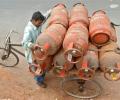
Researchers at CSIR-NCL have developed a technology for producing dimethyl ether (DME) as an alternative to liquefied petroleum gas (LPG), potentially reducing India's reliance on imports and enhancing energy security.

For India, much is at stake: Crucial energy supplies traversing the Strait of Hormuz, the fate of its 10 million citizens living and working in West Asia -- who send generous remittances home -- and its major trade links with the region.

The Indian government has refuted claims of an impending Rs 25-28 per litre hike in petrol and diesel prices post-assembly elections, stating no such proposal is under consideration by the Ministry of Petroleum and Natural Gas.
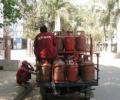
Oil companies begin pilot testing work on direct LPG subsidy.

West Asia conflict triggers sharp sell-off in Indian markets, with realty, banking and auto stocks leading losses amid energy shock fears.

The government has dismissed speculation of an imminent increase in petrol and diesel prices, assuring citizens that there are no plans for a hike despite rising crude oil costs.
Chinese import tariffs have unwittingly come to India's assistance to help boost imports of US liquefied petroleum gas (LPG) at rates cheaper than what it pays for supplies from West Asia, according to industry sources and shipping data.

External Affairs Minister S Jaishankar discussed the West Asia conflict and its impact on energy supplies with his Russian counterpart Sergey Lavrov and EU's Foreign Policy chief Kaja Kallas.

'It was diminishing even before Trump came to power.' 'The US was at the centre of the global economy. That position is going to become less and less important and less central.'

Delhi should keep all its options open in what is essentially a transitional period in the geopolitics of energy rather than remain a gatekeeper serving Trump's 'America First', suggests Ambasssador M K Bhadrakumar.

Saudi Arabia's steep cut in LPG benchmark prices has pushed India's household LPG underrecoveries to their lowest level in over two years, slashing oil companies' losses from Rs 200-250 per cylinder last year to about Rs 20-40 now.

Two Indian ships carrying liquified petroleum gas (LPG) from the Gulf countries crossed the Strait of Hormuz early on Saturday morning, raising the number of Indian vessels safely passing through the war-hit, narrow shipping lane to three.

External Affairs Minister S Jaishankar has emphasised India's commitment to safe maritime transit and condemned attacks on merchant shipping amidst the ongoing West Asia conflict and global energy market disruptions.

Qatar has halted liquefied natural gas (LNG) production after its facilities came under attack amid the ongoing West Asia conflict, disrupting supplies to India and squeezing feedstock availability for key domestic sectors.

Two more Indian-flagged LPG tankers have begun their journey from the Persian Gulf, navigating the Strait of Hormuz amidst regional conflict, following disruptions caused by recent tensions in the Middle East.
India's decision to import LPG from the US helps it to diversify sources as it reduces almost full reliance on West Asian countries for supply of the country's primary cooking fuel.

A senior government official confirms that Indian vessels do not require permission to navigate the Strait of Hormuz, despite regional tensions. Several Indian ships, including LPG tankers, have safely crossed the strait, ensuring continued supply of essential commodities to India.

The Andhra Pradesh government has prepared an action plan for relief and essential supplies in pre-cyclone preparedness for Cyclone Montha, expected to cross the coast on October 28.

Prime Minister Narendra Modi convened the Cabinet Committee on Security to address the impact of the West Asia conflict on Indian citizens, focusing on safeguarding them from the conflict's effects and ensuring the smooth flow of essential supplies.

Reliance Industries on Monday said its city gas would be cheaper by almost 33 per cent compared to liquefied petroleum gas being supplied by oil PSUs.
India possesses approximately 100 million barrels of commercial crude oil stocks, capable of covering 40-45 days of its requirements if flows through the Strait of Hormuz are disrupted, according to Kpler.
